Yes, if
Your currency-pair Strategy runs, or can run, as a Pine Script Strategy on TradingView that fires webhook alerts. Whether you also execute it on MetaTrader 5, on another terminal or not at all is your choice.
A forex applicant often arrives with a MetaTrader 5 account and no idea what Triggon expects of it. Here it is, plainly: your Signals reach Triggon as TradingView alerts, exactly as on every other Algo route. MetaTrader 5 is the terminal you may trade and backtest on, and its Strategy Tester report is accepted as backtest evidence. Triggon connects to neither your broker nor your terminal. This page walks the whole route in order, and does not assume you know MetaTrader 5 terminology.
This route is open for applications right now.
Sample. The enabled pairs and the ceiling are read from the platform's settings.
Your currency-pair Strategy runs, or can run, as a Pine Script Strategy on TradingView that fires webhook alerts. Whether you also execute it on MetaTrader 5, on another terminal or not at all is your choice.
Your Strategy exists only as a MetaTrader 5 Expert Advisor with no TradingView counterpart. Triggon does not receive Signals from a MetaTrader terminal or an Expert Advisor, and this guide does not pretend otherwise. Either port the logic to a Pine Script Strategy, or send the Signals yourself on the forex Manual route.
Same route, different guide: crypto, stocks, commodities (gold and other spot metals are commodities on Triggon, not forex).
Eleven steps. The first seven happen before you open the application; the rest happen inside Triggon. Each links to the section of this page that explains it, and the application's own route screen shows the same list.
A Pine Script Strategy on TradingView, on a chart of the symbols you will declare, on a TradingView plan that can send webhook alerts. Triggon never sees the script itself, only the alerts it fires.
Your broker account, and MetaTrader 5 if you use it, are where you trade and backtest. Triggon does not connect to either: your Signals reach Triggon from TradingView, and an MT5 report is accepted as backtest evidence.
Only pairs Triggon has enabled can be declared. Enabled today: EURUSD. Up to 1 per application.
One alert per declared symbol, firing on entries, stops, targets and exits, with the message shape Triggon reads. The private connection it points at is issued in your Provider Hub after approval.
A TradingView Strategy Tester export (CSV), or a MetaTrader 5 Strategy Tester or History report saved as HTML or XLSX with the terminal language set to English.
Your public name, a one-line summary, a full description, optional links and images. Subscribers read this before they subscribe.
The Hub creation cost, its validity period, the minimum subscription prices for this market and the platform fee are all stated before you apply, from the current platform settings.
The form collects what you prepared and validates it. The Hub creation cost is charged from your Triggon wallet when you submit.
An admin approves, asks for revisions or rejects, always with a reason. Resubmitting after a revision request is free.
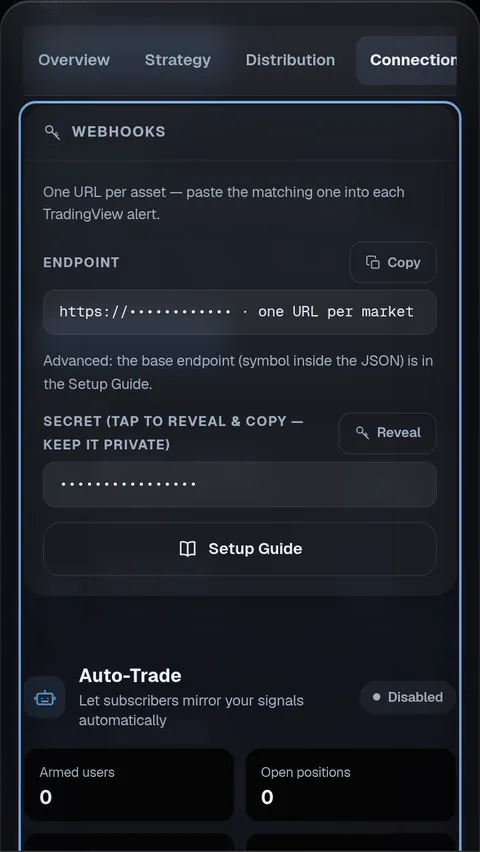
After approval: copy the private connection details, send a test alert for every declared symbol in test mode, verify the health check, then press Go Live.
Go Live lists the Strategy on the Marketplace with the price and seats you set. Every Signal from then on is recorded permanently.
The Signal path. Triggon consumes the alerts your Strategy fires and never runs your script.
What you need. A Pine Script Strategy (a script that places orders in the Strategy Tester, not only an indicator), open on a chart of each pair you will declare, on a TradingView plan that can send webhook alerts. TradingView decides which plans include webhooks; check yours before applying.
Which chart. Any TradingView forex feed of the pair, for example
FX:EURUSD or OANDA:EURUSD. Triggon strips the feed prefix and
reads the pair as EURUSD, which is how it is spelled on Triggon's list. Broker
suffixes you may know from MetaTrader 5 (EURUSDm, EURUSD.a) do
not exist on Triggon; the canonical six letters are the symbol. With your Strategy's
per-pair connection (recommended, see alerts) the pair is fixed by the
connection and the alert need not name it.
Spot or leveraged product. Spot FX on Triggon means a currency pair dealt through a broker on margin, which is leveraged: you declare a leverage band even on Spot. The "Futures" option on this route means a leveraged broker product (margin or CFD), the thing a retail forex Provider usually means by the word. It does not mean exchange-listed currency futures; Triggon has no catalog, price feed or expiry model for those, and does not offer them.
Alert coverage. Entries, stop and target updates, partial closes, target hits, stop hits and closes. A Strategy that alerts on entries and never on exits produces an incomplete record. The TradingView page lists what each alert can express.
Nothing here is required by Triggon. It is here because a forex applicant usually has these two things and needs to know exactly what role they play.
A trading terminal (a desktop program, with mobile and web versions) that forex and CFD brokers give their clients. It is not an exchange and not a broker: it is the software through which you log in to a broker's account, see that broker's prices, place trades, and, in its Strategy Tester, backtest automated strategies called Expert Advisors.
A broker account, opened with the broker, not with MetaTrader. Every broker offers a demo account (virtual money, real prices) and a live one. For preparing a Triggon application a demo account is enough: nothing on this route requires you to fund a live account.
Download the terminal from your broker's website (brokers distribute it) or from the MetaTrader site, install it, then File → Login to Trade Account with the server name, login number and password the broker emailed you. Market Watch (View menu) lists the broker's symbols; right-click it and choose Show All if the pair you need is hidden.
In Market Watch, right-click a symbol and open Specification: it shows the contract
size (100,000 units for a standard lot on the majors), the leverage the account allows and
the trading sessions. If your broker spells the pair EURUSDm or
EURUSD.a, that is the same instrument as Triggon's EURUSD; the
suffix is the broker's, and the MetaTrader 5 report import understands it.
Two things only. Your own execution, if you run the Strategy there: Triggon does not connect to the terminal and does not read your trades from it. And backtest evidence: the Strategy Tester (or History) report you export is accepted by the application in place of a TradingView export. How to export it →
Triggon does not receive Signals from a MetaTrader terminal, does not run an Expert Advisor, does not ask for your terminal login, and does not need your broker's name to map symbols or price them. Naming your broker in the application is optional and only describes where you trade.
Identical to every Algo route: a TradingView alert with a webhook delivery, pointed at the private connection Triggon issues for your Strategy after approval.
Write the alert message in the shape Triggon reads: event type, pair, side, price,
stop, targets and their sizes, and a timestamp from TradingView's
{{timenow}} placeholder. Prices carry up to six decimals, which
covers every pair including the JPY crosses. Confirm in TradingView's alert log that the
Strategy fires on the events you expect.
The Connection tab of your Provider Hub issues one private connection per declared pair and a secret, with ready-made alert messages. One alert per chart, pointed at that pair's connection, and the message needs no symbol field.
Parses and validates an alert completely and stores nothing. Fire your Strategy at it until every declared pair shows a passed test. A refusal names its reason.
The connection itself. Before applying, test that your alerts fire on the right events with the right numbers, and that your backtest export opens and shows the trades you expect.
Either is accepted. After approval the file is imported as the Strategy's historical record, marked as imported.
Strategy Tester properties: initial capital $10000.
Then Strategy Tester → List of Trades → Export (CSV), one file per pair, with the
pair in the file name (for example ..._EURUSD_...).
1. Set the terminal language to English (View → Languages), because the import reads the report's column headers and a localised report is refused rather than guessed at. 2. Run the Strategy Tester on the pair. 3. Right-click the Backtest tab → Report, and save as HTML or XLSX. Or, for a live or demo account's trades: the History tab of the Toolbox → right-click → Report. 4. The report names its own symbols, so the file name does not matter.
The Positions table when the report has one (one row per closed position, correct for netting and hedging accounts), otherwise the Deals table, which the import rebuilds into closed trades. Profit, commission and swap become the net result; the balance column is used as an independent check. Broker symbol spellings are mapped to Triggon's, and the contract size is worked out from the report's own numbers rather than assumed.
Times in an MT5 report are the broker's server time and are imported as such, with no offset invented. And a hedging account should be exported from the History tab so the Positions table is present; the preview says so if it is missing.
Preview before you submit: the application shows how the file was read, the trade count, the date range, the symbols and the headline figures, before anything is stored. Imported history does not count towards the Verified checkmark, which describes Signals Triggon recorded as they happened. What Verified means →
Your name, email and country come from your Triggon Profile and are shown read-only in the application. Complete them in Settings before you start.
A unique English name, a one-line summary for the Marketplace card, a full description, up to three trading styles, a risk level, and the cadence: how often it fires and how long a position typically runs.
Optional: website and social handles (usernames only), a logo, a banner, a profile picture and a cover image.
Read live from the platform settings, per category: forex has its own Hub cost and validity period, which may differ from crypto's.
An illustration computed from the live fee rate, not a forecast or a guarantee. Actual earnings depend on filled seats, cancellations and refunds, promotions, and any automatic Hub top-up. What decides what you earn →
Opened in Telegram. It confirms the route you chose here, links this guide on every step, and asks only for what this page told you to prepare. On this route the venue field is labelled Broker, never Exchange.
Provider info, then the Strategy: name, summary, description, styles, risk level, market: Forex (fixed from your route), Spot or the leveraged product, position mode, the pairs from the picker, your broker (optional, from a list), timeframes, the leverage mode and band, the take-profit method, the maximum capital risk per position, prices and seats. Then the uploads (a TradingView export or a MetaTrader 5 report, optional screenshot and report), branding, operations (cadence, timezone, sessions, off days, optional footer), and the review. You are not asked what fees to assume: Triggon applies the same maker and taker rates to every Strategy, so published results stay comparable.
No MetaTrader login, no broker credentials, no API keys, no connection details: the connection is issued to you after approval. No take-profit ladder; targets are per Signal. No drawdown claim; drawdown is measured.
Every step is saved on the server. Leave and return and you continue where you stopped, with your route, market and answers preserved. Nothing sensitive is stored in your browser.
The route-specific checklist at the end of this page must be confirmed item by item, and the fees and pricing are shown once more. Then Submit and Pay.
Every Signal from Go Live on is permanent and public. Subscribers pay from their Triggon wallet, your share lands in yours, and you withdraw when you choose. Once 20 trades have closed over 30 live days, the Strategy is ranked on the Leaderboard by its Triggon Score.
Complete Signals, an entry with a stop and at least one target, and management of what you open. Keep the Strategy running through the trading week: a Strategy that goes silent is warned, then suspended from the Marketplace with its subscribers told.
Prices (above the minimum), seats, pausing, Hub recharges: yourself, in the Hub. Description, links, images and declared trading facts: reviewed before they go live.
The route (Algo), the market (forex) and the instrument type are fixed at application. A different route or market is a new Strategy.
These are the items the application asks you to confirm before Submit and Pay on the forex Algo route.